 ThisHaircut
Length and shape
| Term | What it means |
|---|---|
| Trim | Taking off the ends to keep the current shape, often half an inch to an inch |
| Dusting | An even smaller trim that takes off little more than the split ends |
| Blunt cut | Ends cut to one line, so the hair looks fuller and heavier at the bottom |
| Layers | Hair cut to different lengths so it has movement and less weight at the ends |
| Long layers | Layers that start low, keeping most of the length and fullness |
| Face-framing layers | Shorter pieces around the face only, the rest of the length unchanged |
| Weight line | The point where the hair looks heaviest; layers move or soften it |
| Graduation or stacking | Shorter at the nape and longer above, building volume at the back of a bob |
| Bob, lob | A bob ends around the jaw; a lob (long bob) ends between the jaw and the shoulders |
| Shag | Many choppy layers, more volume at the crown and lighter ends |
| Pixie | A short cut close to the head at the sides and back, often longer on top |
Fringe and the front
| Term | What it means |
|---|---|
| Fringe or bangs | Hair cut to fall over the forehead; British English says fringe, American English bangs |
| Curtain bangs | A longer fringe parted in the middle that sweeps to both sides |
| Wispy bangs | A thin, see-through fringe rather than a solid one |
| Blunt bangs | A solid fringe cut straight across |
Techniques you may hear
| Term | What it means |
|---|---|
| Point cutting | Cutting into the ends with the scissor tips so they look soft rather than blunt |
| Texturizing or thinning | Removing bulk inside the hair; too much can leave ends wispy, so say if you want to keep fullness |
| Dry cut | Cutting hair dry, so the stylist sees how it falls, useful for curls |
| Scissor over comb | Short hair cut with scissors instead of clippers, softer than a clipper cut |
Barber terms for short cuts
| Term | What it means |
|---|---|
| Taper | Hair gets gradually shorter toward the neck and around the ears; it usually stays longer than a fade |
| Fade | Sides and back blend down to very short or skin; low, mid and high say where the blend starts |
| Skin fade or bald fade | A fade that goes all the way down to bare skin |
| Line up or edge up | Sharp, clean lines at the hairline, temples and beard |
| Blocked or tapered neckline | A square line at the back of the neck, or one that fades out naturally |
| Textured crop | Short on the sides, a choppy top, often with a short fringe |
| Buzz cut | Clipped all over at one or two guard lengths |
Clipper guard numbers
Barbers often say “a two on the sides”. The number is the clipper guard, and each step adds about an eighth of an inch (3 mm) on the most common guard sets. Brands differ slightly, so if you liked a cut, note the numbers your barber used.
| Guard | Length left |
|---|---|
| No guard | About 1/16 inch or less, depending on the clipper |
| #1 | 1/8 inch, about 3 mm |
| #2 | 1/4 inch, about 6 mm |
| #3 | 3/8 inch, about 10 mm |
| #4 | 1/2 inch, about 13 mm |
| #6 | 3/4 inch, about 19 mm |
| #8 | 1 inch, about 25 mm |
Let the card find the words
You don’t have to learn all of this. In ThisHaircut you mark what you like and don’t like on your saved photos, and the AI writes a short card in cutting vocabulary for your stylist, with your own language under every line so you can check it.
iPhone and Android · Free to save looks · No account needed
See how ThisHaircut works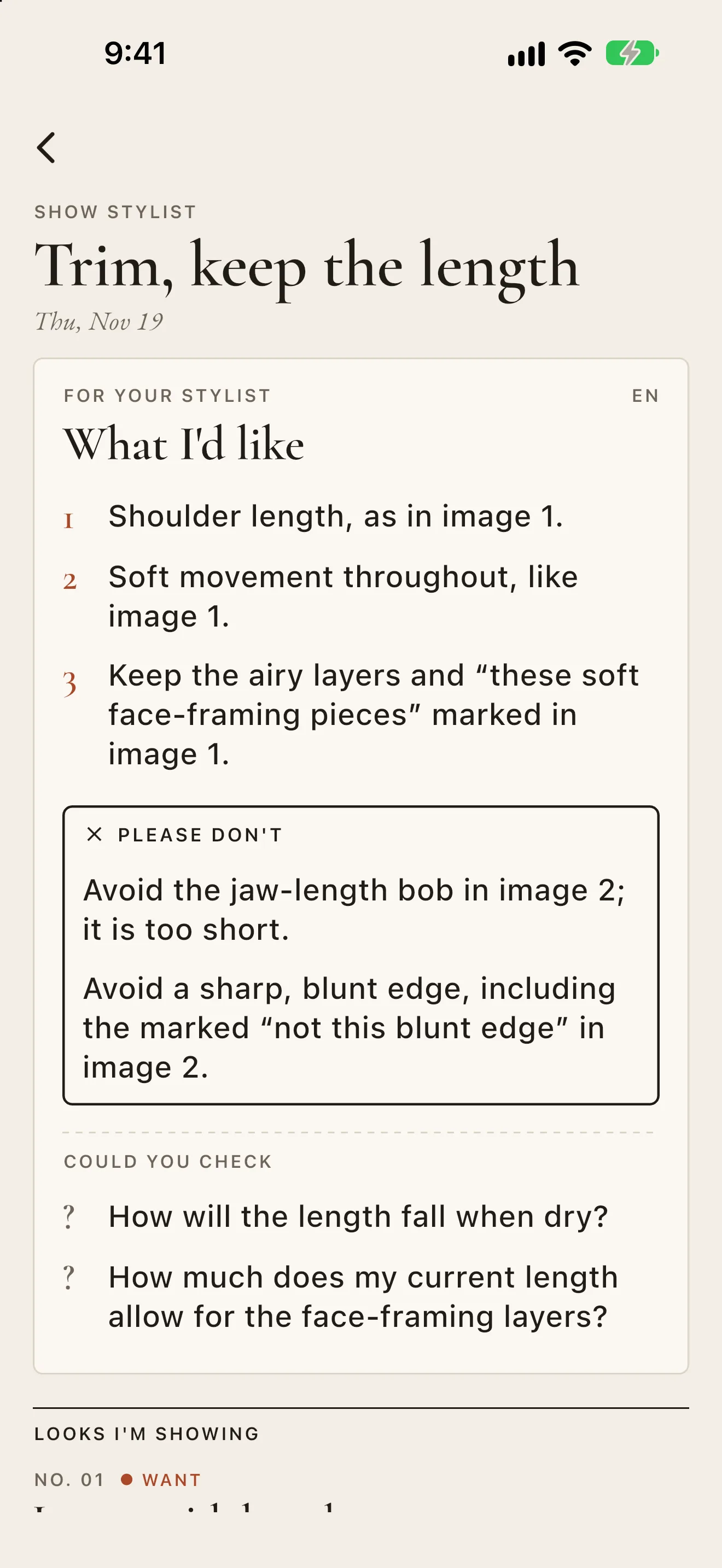
Questions
What is the difference between a taper and a fade?
Both get shorter toward the neck. A taper changes length gradually and usually leaves some hair at the bottom; a fade blends down to very short or bare skin, and its starting height (low, mid, high) changes the look a lot.
Should I ask for thinning?
Only if your hair feels too heavy. Thinning removes bulk, but too much can make the ends look wispy. If you want movement without losing fullness, ask for layers or point cutting instead and say you want to keep the ends full.